The latest market movements surrounding Hang Seng Index (HSI) signal a complex interplay of macroeconomic optimism and equity-specific headwinds. On one hand, a sharp rise in China’s trade surplus has bolstered hopes of economic stabilization; on the other, under-performance by high-profile constituents such as Pop Mart has weighed on the index. Our analysis parses these contrasts, examines the key drivers, and outlines potential near-term outcomes — offering investors a clearer view of what lies ahead for HSI.
China’s Trade Surprise: A Foundation for Confidence
Recent data showed China achieved a robust trade surplus as exports climbed by 5.9% year-on-year, while imports rose a modest 1.9%. TradingView This unexpected resilience in trade flows has fueled hopes that China’s export-led growth momentum might regain strength — a welcome sign amid ongoing global economic uncertainties.
Simultaneously, commodity prices have surged, with copper nearing record highs — a development often interpreted as a bellwether for industrial demand and global economic health. TradingView Given China’s status as a major copper consumer, high copper prices reinforce optimism about demand in manufacturing and infrastructure, potentially benefiting sectors tied to raw-materials, industrial output, and corporate earnings.
Together, China’s trade uptick and strong commodity prices create a backdrop of macroeconomic strength. For equity markets — particularly those with heavy exposure to Chinese demand and global trade cycles, such as HSI — this environment can offer meaningful support.
Hang Seng Under Pressure Despite Favorable Macro Signals
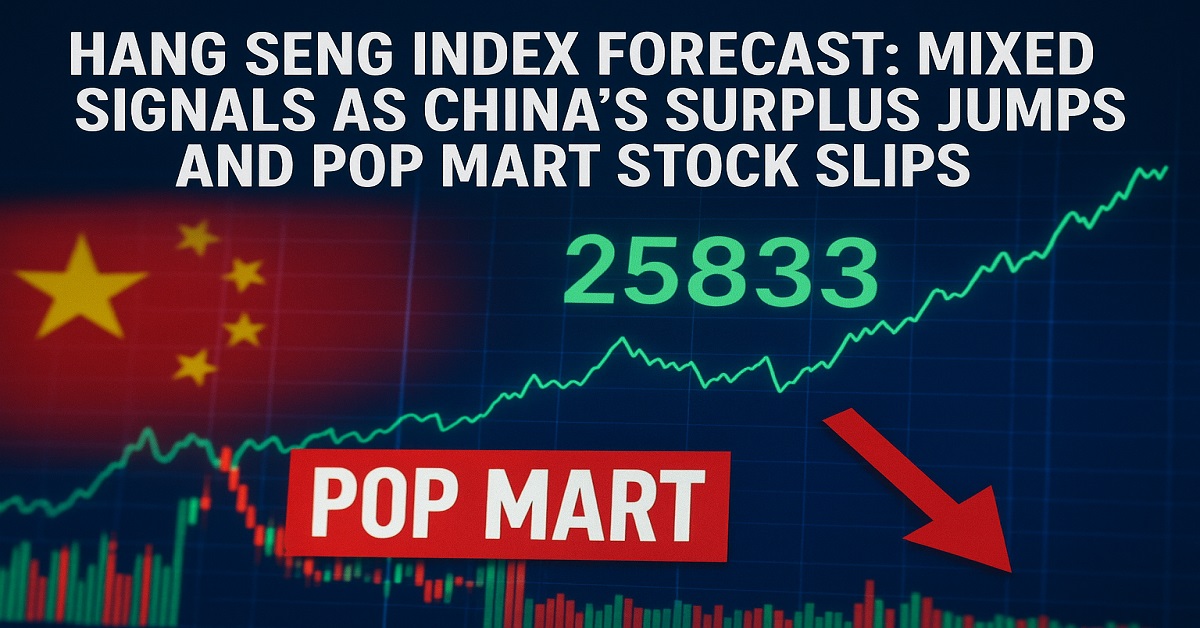
Despite encouraging macro data, the Hang Seng Index didn’t rally. Instead, it pulled back to approximately HK$25,833, down from this year’s high near HK$27,300. TradingView+1
Why the disconnect? The answer lies in market dynamics — specifically, profit taking and selective risk aversion. Even as macroeconomic signals pointed upward, many investors remain cautious, especially ahead of key global catalysts such as the upcoming U.S. Federal Reserve (Fed) interest-rate decision, a move likely to influence global liquidity flows and risk sentiment. TradingView
In technical terms, HSI has been consolidating between roughly HK$25,190 and HK$27,190 for months, reflecting a market stuck in range-bound trading as it awaits a clearer directional cue. TradingView+1 The mild volatility and low directional momentum — as indicated by a depressed Average Directional Index (ADX) — suggest the index may remain in this lateral band until fresh catalysts emerge. TradingView
Thus, even with macro fundamentals improving, prevailing investor caution and index-specific headwinds mean HSI isn’t guaranteed to reflect broader economic optimism — at least in the near term.
Pop Mart: From Index Inclusion to Investor Disappointment
One of the most visible drags on HSI’s recent performance has been Pop Mart. After being added to the Hang Seng Index as part of the quarterly rebalancing — alongside peers such as JD Logistics and China Telecom — Pop Mart was expected to ride the wave of passive inflows from index-tracking funds. South China Morning Post+1
However, market reality has diverged sharply from expectations. On the day of inclusion, Pop Mart’s stock price fell more than 7%, despite its impressive year-to-date rally of over 250%. TradingView+1 The slump suggests that some investors may doubt the durability of its growth — particularly the sustainability of the pop culture / collectible-item boom that drove its earlier surge. Investopedia+1
This kind of investor skepticism can weigh heavily on index performance: when a highly-valued constituent falters, the drag can offset gains elsewhere, as appears to be the case now. For HSI stakeholders, Pop Mart’s slump serves as a cautionary example of concentration risk, speculative excess, and the volatility of retail-driven hype.
Key Index Drivers: What Else Moves Hang Seng Right Now
Beyond Pop Mart and macro trade data, other dynamics are shaping sentiment for the Hang Seng Index:
- Some large-cap stocks posted gains — for instance, analysts pointed to positive movement in firms like Baidu, SMIC, Ping An Insurance, and Geely Automobile, among others. TradingView
- However, other heavyweights — including industrials, energy, and certain Chinese manufacturing names — lagged, partly due to uncertainty about export demand, regulatory pressures, and domestic growth headwinds. TradingView+1
- Market participants are also closely watching external factors: the upcoming Fed decision will influence global capital flows and exchange rates, and any shift may impact the Hong Kong dollar peg via the Hong Kong Monetary Authority (HKMA), exerting additional pressure on Hong Kong-listed equities. TradingView
These mixed signals — pockets of strength alongside pockets of weakness — help explain why HSI remains caught in a consolidation phase, rather than embarking on a definitive uptrend.
What’s Next: Scenarios for HSI’s Near-Term Trajectory
Given the current mix of macro support and micro-level headwinds, investors should keep an eye on the following possible scenarios:
Scenario A: Macro Tailwinds Propel Recovery
If China’s trade surplus continues to expand, and global commodity demand remains strong (particularly for metals like copper), HSI could find renewed strength. Coupled with positive earnings reports from large-cap constituents and stable capital inflows, the index could rally toward the upper bound of its recent range — near the HK$27,000–27,300 zone.
Scenario B: Sideways Movement Amid Cautious Sentiment
With uncertainty over global interest rates, and given Pop Mart’s underperformance and similar volatility in certain sectors, HSI could remain locked in its current consolidation channel. Market participants may prefer to wait on the sidelines until there is more clarity on corporate earnings and liquidity conditions.
Scenario C: Downside Risk If Sentiment Worsens
Should global risk appetite diminish — for example, via adverse geopolitical developments, disappointing economic data, or surprise rate hikes — weaker stocks (especially highly speculative ones like Pop Mart) could drag sentiment lower. In such a case, HSI may test support near HK$25,000 or below.
Investor Takeaways: Cautious Optimism With Selectivity
For investors tracking the Hang Seng Index, the current environment calls for cautious optimism coupled with careful stock selection. Here are our key recommendations:
- Favor blue-chip firms with diversified revenue streams and strong fundamentals over speculative high-volatility names.
- Monitor commodity trends (especially copper), China trade data, and global interest-rate signals — they remain major macro drivers.
- Avoid overconcentration in momentum-driven equities whose valuations may not sustain under stress (e.g., companies in retail, entertainment, or fad-driven sectors).
- Maintain flexibility: with the index trapped in a range, timing of entry and exit becomes critical — consider using technical support/resistance levels (HK$25,200–27,200) to guide investment decisions rather than chasing hype.
Conclusion: Hang Seng Index’s Crossroads — Stability or Volatility?
The recent divergence between China’s upbeat trade data and the underwhelming performance of certain index constituents like Pop Mart underscores the complex dynamics currently shaping HSI. While macroeconomic fundamentals — trade surplus growth, strong commodity demand, and stable export activity — offer a foundation for optimism, micro-level volatility and investor caution present real challenges.
At this juncture, the Hang Seng Index appears to be at a crossroads: it could resume a bullish trajectory if macro tailwinds strengthen and confidence returns — or remain range-bound (or worse) if volatility persists and sentiment remains fragile. For investors, the best approach lies in disciplined selectivity, prudent timing, and a focus on fundamentally solid companies rather than speculative names.