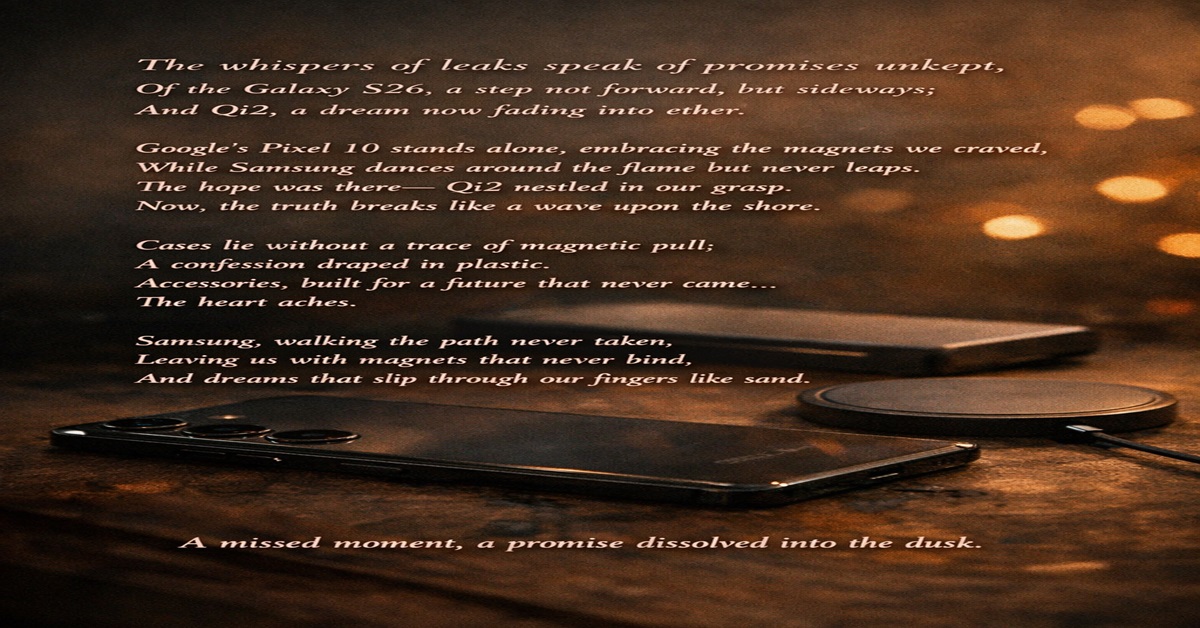
The leaks keep whispering the same bleak refrain: the Galaxy S26 series is not the leap many hoped for. It’s a shuffle, not a stride. And now, with growing certainty, it seems the most anticipated change of all—the arrival of native Qi2 magnets—may never materialize. Cue the melodrama: the day feels dimmer, the letdown oddly profound.
So far, Google’s Pixel 10 lineup stands alone, a quiet overachiever in the Android world, boldly adopting native Qi2 magnets. In doing so, it finally mirrored something Apple normalized half a decade ago and something the industry agreed upon years back. Samsung, by contrast, merely toyed with the idea—outsourcing magnetism to cases rather than weaving it into the phone’s very skeleton. A cautious dance around commitment.
The Galaxy S26 series was meant to be the moment of truth. This was supposed to be Samsung’s full-throated embrace of Qi2, the end of hedging, the start of alignment with where the market is clearly headed.
Early leaks fanned that hope into flame. Designs reportedly accounted for internal Qi2 magnets. Rumors hinted at faster wireless charging, synced neatly with the latest standards. Even more tantalizing, evidence surfaced of Samsung crafting dedicated Qi2 accessories for the Galaxy S26 family—a magnetic power bank sculpted around the camera bump, a MagSafe-style charging puck promising elegant convenience. All signs pointed forward.
And yet, as more details seeped out, certainty began to rot at the edges. Doubt crept in. Back and forth it went—optimism wrestling skepticism—until a fresh leak from Nieuwemobiel seemed to land the decisive blow. The message was stark: the Galaxy S26 series is unlikely to house native Qi2 magnets at all.
This same leak, while shedding light on refinements to the Galaxy S26 Ultra’s S Pen, also revealed Samsung’s own first-party cases. Some magnetic. Some conspicuously not. That single detail speaks volumes. The existence of an official non-magnetic case all but extinguishes the possibility of native Qi2 support. It’s a quiet confession disguised as an accessory lineup.
Here’s the unglamorous physics of it all: Qi2 magnets embedded in a phone perform beautifully—until a case enters the equation. Any case with meaningful thickness weakens the magnetic bond, leaving mounts, wallets, and accessories clinging on with false confidence. That’s why true Qi2 phones rely on magnetized cases, especially first-party ones. The case restores the grip. Without it, the feature cannibalizes itself. No one wants protection that sabotages functionality.
Yes, there remains a slim chance that Samsung presses ahead with internal magnets regardless. But the evidence weighs heavily in the opposite direction. The signs suggest a familiar retreat, another skipped beat, another “maybe next year.” It would hardly shock anyone to learn that Samsung once had Qi2 firmly on the roadmap, only to erase it when the Galaxy S26 plans were redrafted in the shadow of the iPhone 17’s debut.
What’s more telling is the consistency of absence. These non-magnetic cases appear not just for the Galaxy S26 and S26+, but for the Ultra as well. The omission is comprehensive. No magnets anywhere. A clean sweep.
And yes—this stings. Personally, deeply. Qi2 has been the standout evolution of the Pixel 10 series, a daily reminder of how small conveniences can quietly transform use. Many feel the same. Watching Samsung sidestep it yet again feels borderline irrational. This isn’t a fringe novelty. It’s a feature people want, one the market expects. Apple lit the path, handed over the blueprint, and Samsung still refuses to walk it.
What truly baffles me, though, is the contradiction at the heart of all this. Samsung is building magnetic accessories—chargers, power banks—while shipping phones that can’t properly support them out of the box. Imagine the excitement of a Galaxy S26 Ultra buyer, proudly picking up a first-party Samsung case, spotting a sleek new magnetic charger… only to discover it’s useless unless they buy a different case. The absurdity borders on parody.
Most likely, these accessories are relics of an earlier plan, echoes from a timeline where Qi2 survived the internal debates. But to the customer, it’s just confusion layered on disappointment. It muddles the message, fractures trust, and casts Samsung in an unflattering light.
This wasn’t just a missed upgrade. It feels like a missed moment.