GitHub Copilot Gets Faster AI Assistance with Claude Opus 4.6 Preview
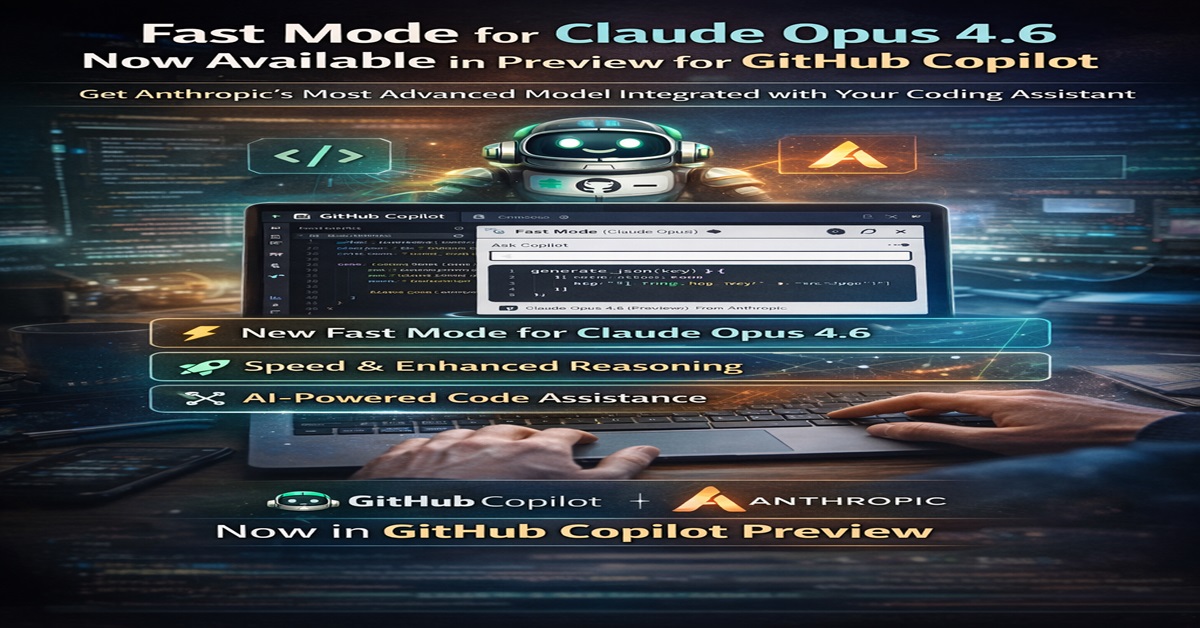
GitHub Copilot users can now access a preview of Fast mode for Claude Opus 4.6, marking a significant milestone in the evolution of AI-assisted software development. This integration brings Anthropic’s most advanced reasoning model directly into one of the world’s most widely-used coding assistants, offering developers a powerful new option for tackling their daily programming challenges.
A Major Step Forward for AI-Assisted Development
The preview release represents a convergence of two leading forces in AI technology: GitHub’s pioneering work in code assistance and Anthropic’s cutting-edge language models. Claude Opus 4.6, the flagship model in Anthropic’s Claude 4.5 family, is renowned for its exceptional reasoning capabilities, nuanced understanding of complex instructions, and ability to handle sophisticated multi-step tasks. Now, with Fast mode optimization, these capabilities are being tailored specifically for the rapid-fire nature of software development workflows.
For developers who have been following the evolution of AI coding assistants, this announcement signals an important shift. The integration acknowledges that modern software development requires both depth and speed—developers need an AI partner that can engage with complex architectural decisions while also keeping pace with the iterative nature of coding.
Understanding Fast Mode
Fast mode is designed to optimize Claude Opus 4.6’s response times for common development tasks without sacrificing the model’s core strengths. While Claude Opus models are capable of deep, thoughtful analysis that sometimes requires additional processing time, many coding scenarios demand quicker turnaround. Fast mode strikes a balance, providing rapid assistance for straightforward tasks like code completion, syntax corrections, and common refactoring operations, while still maintaining access to the model’s advanced reasoning when needed.
This optimization is particularly valuable in active coding sessions where developers are in a flow state. Whether writing a new function, debugging an issue, or exploring different implementation approaches, the reduced latency can make the difference between a seamless experience and one that disrupts concentration.
The mode doesn’t simply sacrifice quality for speed. Instead, it represents careful engineering to identify which tasks benefit most from immediate responses and which require the full depth of Claude Opus 4.6’s capabilities. This intelligent routing ensures developers get the best possible experience across different types of coding activities.
What This Means for GitHub Copilot Users
GitHub Copilot has already transformed how millions of developers write code, offering context-aware suggestions and helping accelerate everything from boilerplate generation to complex algorithm implementation. The addition of Claude Opus 4.6 with Fast mode expands the platform’s capabilities in several important ways.
First, it provides developers with greater choice in their AI assistant. Different models excel at different tasks, and having access to Claude Opus 4.6 means developers can leverage a model known for its strong reasoning abilities, sophisticated understanding of context, and ability to handle nuanced instructions. This is particularly valuable for complex refactoring tasks, architectural decisions, or situations where understanding the broader context of a codebase is essential.
Second, the integration demonstrates GitHub’s commitment to a multi-model future. Rather than locking users into a single AI approach, GitHub Copilot is evolving into a platform that can leverage the strengths of different models. This flexibility ensures developers can choose the right tool for each specific challenge they face.
Third, Fast mode’s optimization for development workflows suggests that both companies understand the unique demands of coding assistance. Unlike general-purpose chat applications, code editors require AI that can operate at the speed of thought, providing assistance that enhances rather than interrupts the creative process of programming.
Practical Applications
The preview release opens up numerous practical applications across the software development lifecycle. During the initial coding phase, developers can use Claude Opus 4.6 to generate function implementations, suggest optimal data structures, or provide alternative approaches to solving specific problems. The model’s strong reasoning capabilities make it particularly adept at understanding complex requirements and translating them into working code.
For debugging sessions, Claude Opus 4.6 can analyze error messages, examine stack traces, and suggest potential fixes while considering the broader context of the application. Its ability to reason about code behavior makes it valuable for identifying not just syntax errors but logical issues that might be harder to spot.
When refactoring existing code, developers can leverage the model’s understanding of code patterns and best practices. Whether modernizing legacy code, improving performance, or enhancing maintainability, Claude Opus 4.6 can suggest transformations while preserving the original functionality and explaining the rationale behind each change.
Documentation is another area where the integration shines. Claude Opus 4.6 can generate comprehensive comments, write clear function documentation, and even create README files that accurately explain complex codebases. Its language capabilities ensure that documentation is not just accurate but also clear and accessible to other developers.
The Preview Period: What to Expect
As a preview release, this integration provides an opportunity for early adopters to explore Fast mode’s capabilities while helping shape its future development. Preview periods are crucial in the software industry—they allow real-world testing at scale, surface edge cases that might not appear in controlled environments, and gather feedback from the diverse range of developers who will ultimately rely on these tools.
Developers participating in the preview should expect ongoing refinements as GitHub and Anthropic collect usage data and user feedback. Response times may be optimized further, the balance between speed and depth may be fine-tuned, and new features could be added based on common use cases that emerge during testing.
It’s also worth noting that preview features sometimes have usage limitations or may not be available to all users immediately. Developers interested in trying Fast mode should check their GitHub Copilot settings and documentation for information about availability and any requirements for participation.
Broader Industry Implications
This collaboration reflects broader trends in the AI and developer tools industries. As AI models become more sophisticated and specialized, partnerships between model providers and application developers are becoming increasingly common. These collaborations allow each party to focus on their core strengths—Anthropic on developing advanced AI models, GitHub on creating exceptional developer experiences.
The integration also highlights how AI-assisted development is maturing beyond simple code completion. Modern AI coding assistants are evolving into comprehensive development partners capable of engaging with every aspect of the software creation process, from initial design through implementation, testing, and maintenance.
Looking to the Future
While this preview focuses on Fast mode for Claude Opus 4.6, it likely represents just the beginning of deeper integration between Claude models and GitHub Copilot. As both platforms continue to evolve, developers can anticipate further optimizations, expanded capabilities, and potentially access to other models in the Claude family for different use cases.
The success of this preview will help determine how AI model choice becomes integrated into developer workflows. Will developers prefer to stick with a single model, or will they actively switch between different models based on the task at hand? The answers to these questions will shape the next generation of development tools.
For now, developers have an exciting opportunity to experience one of the most capable AI models available, optimized specifically for coding tasks and integrated directly into their development environment. The preview period will reveal just how transformative this combination can be for software development productivity and creativity.