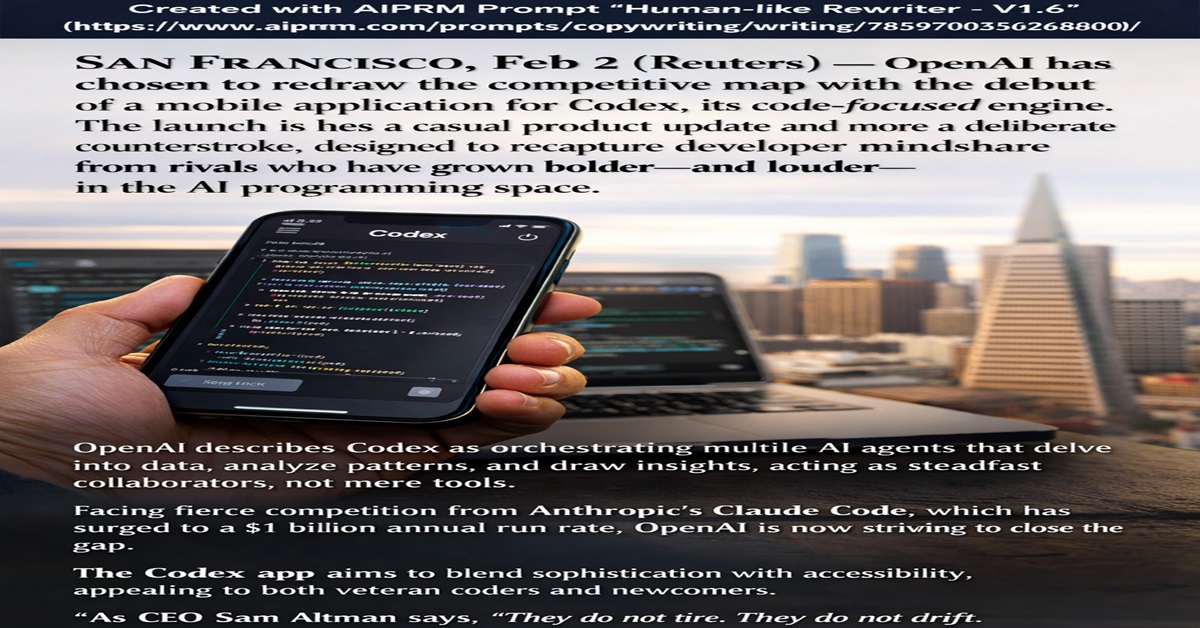
OpenAI is stepping onto new ground with the release of a mobile application for its coding engine, Codex, a move clearly aimed at reclaiming attention—and market share—from increasingly assertive competitors in the AI-driven programming arena.
According to OpenAI, the Codex app has been architected to let users orchestrate several artificial-intelligence agents at once, not just fleetingly, but across extended stretches of work. These agents can be tasked with writing code that doesn’t merely execute commands, but also hunts for data, dissects it, and distills insights along the way. Company executives outlined these ambitions during a briefing with journalists, framing Codex as more of a long-haul collaborator than a momentary helper.
Software development has emerged as one of the clearest victories for modern AI systems. Over the past few years, coding assistants have shifted from novelty tools to near-essentials, becoming a primary hook for AI startups chasing enterprise clients. As demand has surged, so has rivalry, turning the code-generation landscape into a crowded and fiercely contested battleground.
Despite its reputation, OpenAI has found itself trailing in this particular race. The gap is most visible when compared with Anthropic, whose Claude Code has become a dominant force among developers. Anthropic has stated that Claude Code climbed to an annualized revenue run rate of $1 billion within just six months of its public debut—a figure that underscores how quickly developers are willing to embrace tools that genuinely accelerate their craft.
The Codex app, unveiled on Monday, signals a renewed push by OpenAI to close that distance. Beyond raw capability, the company says it has focused on smoothing the user experience, sanding down the rough edges that often intimidate non-experts. The goal, OpenAI suggests, is not only power, but approachability—bringing sophisticated coding assistance within reach of a broader audience.
Industry watchers remain cautious. Few believe today’s code-generation systems are ready to fully supplant human engineers. The tools still stumble, still require oversight, still lack intuition. Yet their value is undeniable. They compress timelines, reduce drudgery, and allow developers to move faster than ever before.
As CEO Sam Altman has remarked, the models possess a peculiar advantage: unlike people, they don’t fatigue, they don’t lose focus, and they never run out of drive.