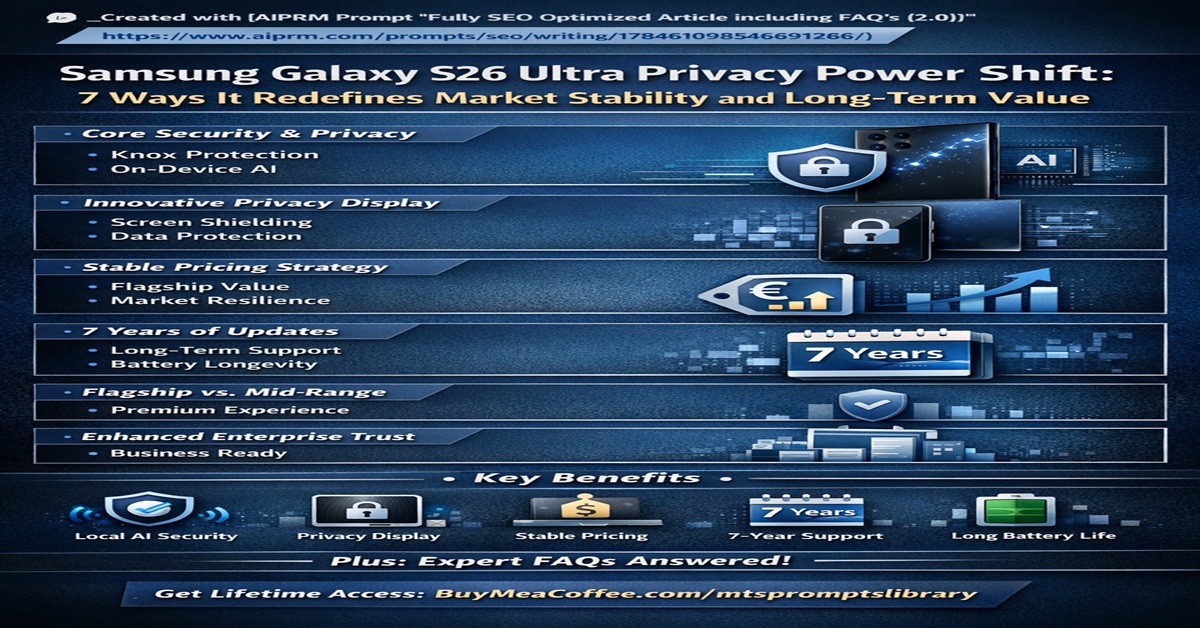
Samsung Galaxy S26 Ultra privacy innovations, on-device AI, long-term pricing strategy, and 7-year support combine to redefine flagship value and market stability.
Introduction: Privacy, AI, and the New Flagship Philosophy
The Samsung Galaxy S26 Ultra represents more than just another yearly smartphone upgrade. Instead, it signals a shift in how flagship devices are designed, priced, and trusted. Today’s smartphone buyers don’t just want faster chips or better cameras — they want security, stability, and longevity. And honestly, that makes sense. Smartphones hold our photos, finances, conversations, and work lives. Privacy isn’t optional anymore; it’s expected.
Samsung already leans heavily into privacy and security on Galaxy devices, with protections built in from the chipset up through Samsung’s security framework. This layered approach means sensitive data can stay local rather than constantly traveling to the cloud. As a result, users benefit from both stronger protection and faster AI features.
At the same time, the smartphone market is entering a period of volatility. Rising memory costs, tighter supply chains, and growing hardware complexity mean flagship pricing strategies matter more than ever. Samsung’s approach with the Galaxy S26 Ultra shows a deliberate effort to maintain long-term value while reinforcing the Ultra model as the premium anchor of its lineup.
Let’s break down how privacy innovation, pricing decisions, AI processing, and long-term support combine to redefine what flagship stability really means.
Privacy Foundations: Security Built From the Chipset Up
One of the biggest strengths of the Galaxy S26 Ultra lies in its deep security architecture. Rather than treating privacy as an add-on feature, Samsung integrates it into the device’s core hardware and operating layers.
This approach starts at the silicon level. Secure processing environments isolate sensitive tasks like biometric authentication, encryption, and credential storage. In simple terms, your passwords and fingerprints don’t mix with regular apps or system processes. That separation dramatically reduces vulnerability to malware or unauthorized access.
Why Hardware-Level Security Matters
Hardware-level protection offers several advantages:
- Reduced attack surface – hackers can’t easily access isolated secure zones
- Stronger encryption handling – keys never leave protected hardware
- Safer biometric verification – fingerprint and face data remain local
- Enterprise-grade trust – organizations can deploy devices confidently
For everyday users, this means peace of mind. For professionals, it means compliance readiness. And for enterprises, it means scalable device security without complicated setups.
Local Processing Strengthens Privacy
The Galaxy S26 Ultra pushes more intelligence onto the device itself. That includes AI tasks like:
- Photo enhancement
- Voice transcription
- Personal recommendations
- Contextual automation
When these features run locally, your data doesn’t need to be uploaded to remote servers. This reduces latency, increases speed, and prevents unnecessary exposure of private information.
Put simply: local AI equals safer AI.
Privacy Display Technology and Real-World Benefits
Another expected highlight is the privacy display capability. While smartphone screens keep getting brighter and sharper, privacy hasn’t always kept pace. A privacy-focused display aims to solve that.
How Privacy Displays Help
These displays can:
- Narrow viewing angles to block side glances
- Automatically detect shoulder-surfing risks
- Dim sensitive content when others are nearby
- Protect banking or work information in public
Imagine checking financial details on a crowded train or reviewing confidential documents in a café. Instead of worrying about who’s watching, the phone actively protects your visibility.
Practical Everyday Uses
Privacy displays benefit:
- Students reviewing exam notes in class
- Professionals reading confidential emails on flights
- Travelers entering passwords in public spaces
- Content creators managing accounts safely
It’s a small feature with a big psychological impact — users feel safer interacting with their phones anywhere.
Why Agentic AI Requires On-Device Intelligence
Modern smartphones increasingly rely on AI assistants capable of proactive suggestions and automated actions. This “agentic AI” concept means the device anticipates user needs rather than waiting for commands.
However, scaling such intelligence purely in the cloud would be inefficient and risky.
Limitations of Cloud-Only AI
Cloud processing requires:
- Constant internet connection
- Continuous data synchronization
- Higher latency for responses
- Greater privacy exposure
If your phone needed the cloud for every contextual action, battery life would drop, performance would slow, and privacy risks would multiply.
Advantages of Local Agentic AI
On-device AI enables:
- Instant offline responses
- Lower bandwidth usage
- Stronger privacy protection
- Personalized learning stored locally
This design also future-proofs the device. As AI capabilities grow, phones must handle more processing independently. The Galaxy S26 Ultra’s architecture seems aimed exactly at that future.
Samsung’s Influence on Market Privacy Expectations
When a major manufacturer emphasizes privacy as a baseline feature, competitors typically follow. That’s how fingerprint sensors, waterproofing, and long software support became industry standards.
Samsung’s focus on:
- Local AI processing
- Hardware-level encryption
- Privacy-centric display technology
- Extended update guarantees
…signals that privacy is no longer a premium extra — it’s becoming mandatory.
This shift benefits consumers broadly. Even people who never buy a Galaxy device may see stronger privacy protections across the industry because of this competitive pressure.
For a broader look at smartphone security best practices, you can review guidance from the National Cyber Security Centre:
https://www.ncsc.gov.uk/guidance/smartphone-security
Market Volatility and the Galaxy S26 Ultra Pricing Strategy
The smartphone industry faces rising production costs driven by:
- Memory price increases
- Advanced chip manufacturing costs
- Supply chain disruptions
- Higher R&D investment in AI
In such conditions, companies must choose whether to:
- Raise prices significantly
- Reduce hardware quality
- Shift focus to mid-range models
- Stabilize flagship pricing strategically
Samsung appears to favor the fourth option.
Protecting the Ultra as the Brand Anchor
If the Galaxy S26 Ultra matches the S25 Ultra’s pricing while base models rise slightly, the Ultra effectively becomes the best perceived value in the lineup.
That perception matters enormously in consumer psychology.
Buyers often reason:
- “If I’m paying close to flagship price anyway…”
- “…I might as well get the top model.”
This strengthens the Ultra’s status as the aspirational device while keeping the product hierarchy clear.
Mid-Range vs Flagship: Managing Value Perception
Smartphone brands must balance two risks:
- Making mid-range phones too attractive
- Making flagship phones too expensive
If mid-range models offer near-flagship features at far lower prices, customers shift downward. Conversely, if flagships deliver clear long-term value, buyers stretch upward.
Samsung’s strategy suggests:
- Base models: accessible entry point
- Plus models: balanced upgrade option
- Ultra model: premium long-term investment
This ensures the flagship remains the most compelling choice for users seeking durability, performance, and future readiness.
Seven Years of Updates and True Device Longevity
Software longevity is becoming one of the strongest selling points in modern smartphones. Seven years of updates mean:
- Security patches remain current
- Apps stay compatible
- Performance optimization continues
- Device resale value improves
Why Hardware Must Match Software Support
Long support only works if hardware survives physically.
That includes:
- Battery durability
- Thermal efficiency
- Storage reliability
- Build quality
Samsung’s design philosophy suggests the S26 Ultra aims to maintain performance throughout the full support window rather than peak early and decline quickly.
Battery Health Strategy: Slower Charging for Longer Lifespan
Some competitors push ultra-fast charging speeds above 100W. While impressive on paper, extremely fast charging can stress battery chemistry over time.
Samsung’s comparatively moderate charging speeds may actually be intentional.
Benefits of Controlled Charging Speeds
- Reduced battery heat
- Slower chemical degradation
- More consistent long-term capacity
- Safer overnight charging behavior
If a phone retains strong battery health after five or six years, users experience genuine long-term value — not just theoretical support.
In that sense, slower charging isn’t a weakness; it’s a durability feature.
What Consumers Gain From This Strategy
The Galaxy S26 Ultra’s combined approach offers:
| Benefit | User Impact |
| Local AI processing | Faster, more private experiences |
| Hardware security layers | Strong protection for sensitive data |
| Stable flagship pricing | Predictable upgrade planning |
| Long software support | Extended device lifespan |
| Battery preservation focus | Reliable multi-year performance |
These advantages transform the phone from a yearly upgrade product into a multi-year investment.
Enterprise and Professional Reliability
Businesses increasingly choose smartphones based on:
- Security compliance
- Update guarantees
- Data protection capabilities
- Lifecycle predictability
The Galaxy S26 Ultra’s privacy-first architecture and long support cycle make it attractive not only to consumers but also to corporate deployments.
For IT departments, fewer replacements and safer data handling translate into lower operational risk.
Future Outlook: A New Era of Stable Flagships
Looking ahead, the smartphone industry may divide into two camps:
- Disposable annual-upgrade phones
- Long-term flagship investments
Samsung’s strategy positions the Galaxy S26 Ultra firmly in the second category.
If successful, this model could influence the broader market toward:
- Longer device ownership cycles
- Greater privacy expectations
- More on-device AI processing
- Stable flagship pricing tiers
That would ultimately reshape how consumers evaluate smartphone value.
FAQs
1. Will the Galaxy S26 Ultra really focus more on privacy than previous models?
Yes. The device is expected to expand local AI processing, hardware security integration, and privacy-display features, strengthening protection compared to earlier generations.
2. Why is on-device AI better for privacy?
Because data doesn’t need to leave the phone. Local processing reduces exposure to cloud breaches and speeds up response time.
3. Is slower charging actually beneficial?
In many cases, yes. Moderate charging speeds reduce battery wear, helping maintain capacity over several years.
4. How do seven years of updates help users?
They keep the phone secure, compatible with new apps, and functional much longer, increasing overall value.
5. Will flagship pricing remain stable long term?
Stability depends on component costs, but Samsung’s strategy suggests maintaining the Ultra model’s value perception is a priority.
6. Is the Ultra model better than mid-range phones for long-term use?
Typically yes. Flagships often receive longer support, stronger hardware durability, and better resale value.
7. Does privacy display technology drain battery?
Most implementations are optimized to activate only when needed, minimizing additional power consumption.
Conclusion
The Samsung Galaxy S26 Ultra reflects a broader transformation in smartphone design philosophy. Instead of chasing only short-term performance gains, it emphasizes privacy, stability, and longevity. By strengthening hardware-level protection, enabling local AI intelligence, stabilizing flagship pricing, and supporting devices for up to seven years, Samsung is redefining what premium smartphone value truly means.
In a market shaped by rising costs and growing privacy concerns, this approach doesn’t just improve one device — it pushes the entire industry toward more responsible innovation. And for consumers, that means smarter investments, safer data, and phones designed to last far beyond the typical upgrade cycle.