What is Adaptive Software Development?
In a world where requirements shift overnight and customer needs evolve faster than sprint cycles, traditional planning models often crumble under pressure. Adaptive Software Development was built precisely for that reality.
Adaptive Software Development (ASD) is an agile software development methodology that embraces change, uncertainty, and collaboration as fundamental drivers of high-quality software. Developed by Jim Highsmith and Sam Bayer in the 1990s, ASD was a direct response to the rigidity of traditional waterfall models — offering teams a framework that could evolve alongside the complexity of real-world projects.
Rather than treating a project as a predictable, linear sequence of steps, ASD treats it as a living, adaptive system — one that continuously learns, adjusts, and improves based on feedback from stakeholders and the environment.
The Origins of Adaptive Software Development
ASD emerged from the broader agile movement of the late 1980s and 1990s, when software engineers began questioning why so many large projects failed despite meticulous planning. Jim Highsmith — drawing on the theories of complex adaptive systems from the Santa Fe Institute — proposed that software development was not an engineering problem to be solved through control, but a complex adaptive challenge to be navigated through collaboration and emergence.
The methodology was formally described in Highsmith’s 2000 book Adaptive Software Development: A Collaborative Approach to Managing Complex Systems, which laid out the philosophical and practical foundations of the framework. Highsmith later became a founding signatory of the Agile Manifesto in 2001, cementing ASD’s place at the heart of the agile movement.
Software development is not a linear process — it’s a complex adaptive system. The goal isn’t to eliminate uncertainty, but to thrive in spite of it.
Jim Highsmith, Adaptive Software DevelopmentCore Philosophy: Embracing Complexity
The intellectual foundation of ASD is the science of complexity theory — specifically, the observation that many real-world systems are too complex to plan in full detail at the outset. Instead of trying to predict every variable, ASD embraces several key philosophical tenets:
Emergence
The best solutions don’t come from upfront design — they emerge from iterative learning, experimentation, and collaboration between teams and stakeholders.
Collaboration
ASD treats customer involvement not as a phase or milestone but as a continuous, integrated part of the development process from start to finish.
Learning
Every cycle is a learning event. Teams systematically gather feedback, reflect on what happened, and use that insight to improve future iterations.
This philosophy stands in sharp contrast to command-and-control methodologies where change is seen as failure. In ASD, change is the mechanism through which quality is actually achieved.
The Three Phases of ASD
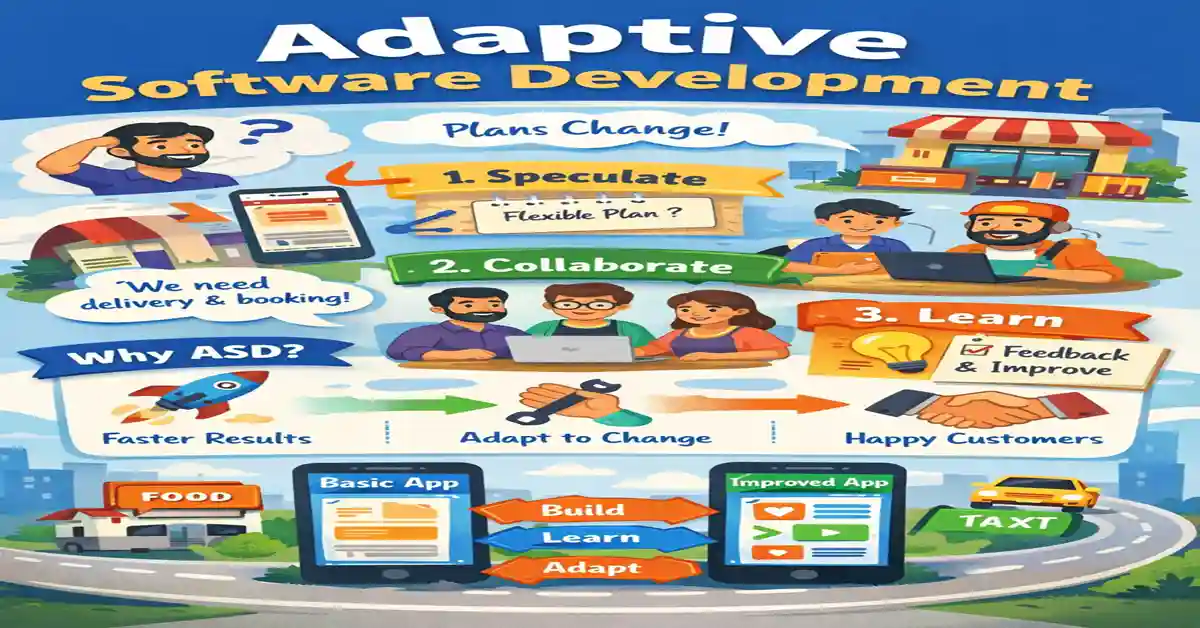
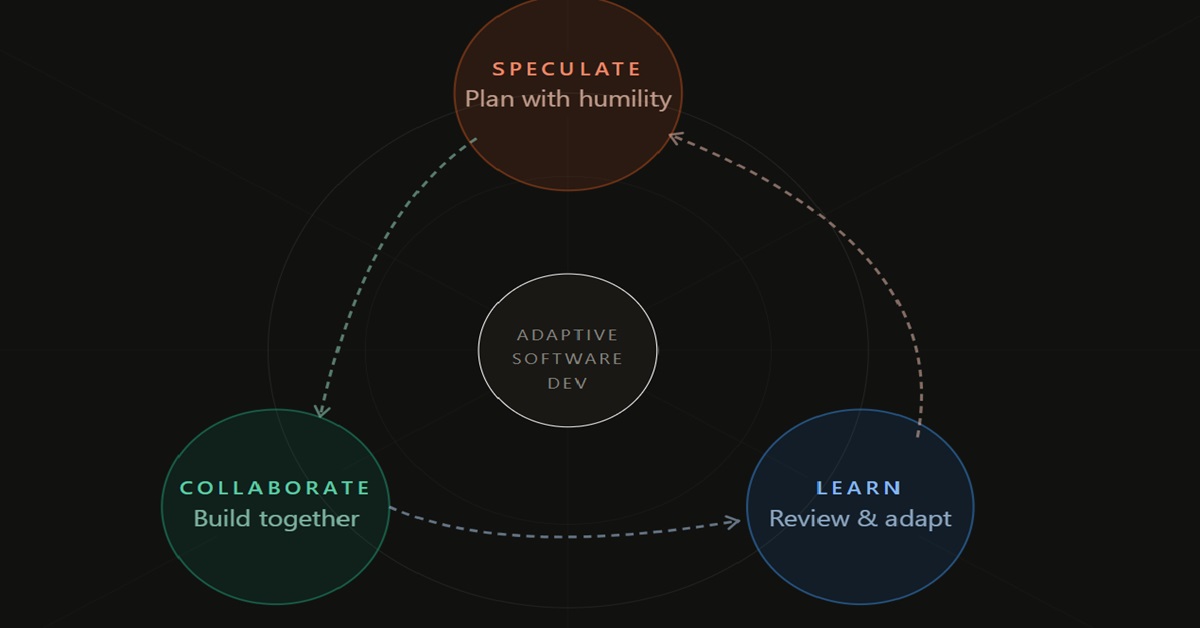
ASD organizes development into a repeating cycle of three core phases, each designed to reinforce the others. Unlike a waterfall model where phases are traversed once and in sequence, ASD cycles through these phases repeatedly — typically in short iterations of two to four weeks.
Phase 01
Speculate
Teams plan with humility, knowing that plans will change. Instead of locking down requirements upfront, they set a mission, identify a rough scope, and establish the adaptive cycle schedule. This phase replaces the rigid “requirements gathering” of waterfall models with a more honest, probabilistic view of what is known and what is not.
Phase 02
Collaborate
This is where the actual building happens. Developers, customers, and stakeholders work together in tight-knit, concurrent cycles. Features are built in parallel, problems are surfaced quickly, and communication replaces documentation as the primary vehicle for shared understanding. ASD strongly emphasizes joint application development (JAD) sessions during this phase.
Phase 03
Learn
At the end of each cycle, the team conducts a formal quality review and a retrospective. They examine what worked, what didn’t, and — critically — whether the project’s direction still makes sense in light of what they’ve learned. This is not just a review meeting; it is the engine that drives continuous improvement across the entire project lifecycle.
These three phases then repeat. Each new cycle begins with another round of Speculation, informed by what was learned in the previous cycle. This creates a spiral of increasing clarity and quality over time.
Six Key Principles of ASD
Highsmith identified six core principles that distinguish adaptive software development from other frameworks:
-
Mission-driven Every adaptive cycle is grounded in a clear mission statement — a concise description of the project’s purpose and goals — which anchors the team even as details shift and evolve.
-
Feature-based Work is organized around customer-valued features rather than internal tasks or technical components. This keeps teams aligned with actual business value rather than technical bookkeeping.
-
Iterative Development happens in repeated, time-boxed cycles. Each cycle delivers working software, not just documentation or partial components.
-
Time-boxed Cycles have fixed durations, typically two to four weeks. Rather than extending a cycle when work overruns, scope is adjusted to fit the time available — a disciplined form of reality-checking.
-
Risk-driven High-risk features are tackled early and often in dedicated cycles, ensuring that the most critical uncertainties are resolved before they become costly late-stage problems.
-
Change-tolerant ASD explicitly designs its planning and review processes to welcome change at any point in the project — not just at the beginning — treating change as a signal of learning rather than a failure of planning.
ASD vs. Other Agile Frameworks
ASD shares many values with Scrum, Kanban, and Extreme Programming (XP), but it has a distinct character — particularly in its philosophical grounding and its explicit emphasis on learning as a first-class activity.
| Dimension | ASD | Scrum | XP |
|---|---|---|---|
| Philosophical basis | Complexity theory, emergence | Empirical process control | Engineering practices |
| Planning approach | Speculate (adaptive) | Sprint planning (structured) | Release & iteration planning |
| Customer role | Continuous collaborator | Product Owner (representative) | On-site customer |
| Core loop | Speculate → Collaborate → Learn | Plan → Sprint → Review → Retro | Plan → Code → Test → Release |
| Documentation | Minimal; collaboration-first | Minimal; story-driven | Minimal; code-driven |
| Prescribed roles | Minimal | Strong (SM, PO, Dev team) | Moderate (coach, customer, dev) |
Where Scrum is more prescriptive about ceremonies and roles, ASD is more philosophically open — offering a mindset and a lightweight lifecycle rather than a rigid set of rules. This makes it particularly suited to research-heavy projects, product discovery, and any context where the goal itself is not yet fully understood.
When to Use Adaptive Software Development
ASD is not the right choice for every project. It thrives in environments characterized by high uncertainty, evolving requirements, and a need for close stakeholder collaboration. It may be less suited to highly regulated industries or projects with strictly fixed scope and budget.
ASD is a strong fit when…
- Requirements are unclear or likely to change significantly over time
- Customers and end users can be engaged throughout the development process
- The project involves novel or research-driven challenges
- The team is small to medium-sized and values autonomy
- Speed to market and responsiveness to feedback are critical success factors
- The domain is complex and emergent (e.g., AI products, SaaS platforms, UX-heavy consumer apps)
Conversely, ASD may struggle in contexts where regulatory compliance demands exhaustive upfront documentation, where contracts are fixed-price and fixed-scope, or where team members are geographically distributed and collaboration is difficult to sustain in practice.
Real-World Applications
While ASD is less formally adopted than Scrum or SAFe, its principles are deeply embedded in many modern software teams — often without those teams explicitly labeling their approach as “ASD.” Companies building consumer internet products, AI applications, and developer tools frequently operate in the speculate-collaborate-learn loop, even if they call it something else.
Notable domains where ASD principles are commonly applied include:
Product startups
Early-stage companies in discovery mode use ASD’s speculative planning and learning cycles to iterate rapidly on product-market fit without over-investing in brittle roadmaps.
Machine learning projects
ML development is inherently uncertain — model performance only becomes clear through experimentation. ASD’s tolerance for change and emphasis on learning makes it a natural companion.
UX-driven design
Teams building user-facing software benefit from ASD’s continuous collaboration model, running frequent user testing and feedback sessions between cycles.
Benefits and Challenges
Benefits
Teams that apply ASD effectively often report higher customer satisfaction because stakeholders are embedded in the process rather than just informed at the end. The framework’s emphasis on learning reduces the risk of building the wrong product, and its acceptance of change reduces the organizational friction that comes with scope evolution. By tackling high-risk features early, teams surface problems when they are still cheap to fix.
Challenges
The very openness that makes ASD powerful can also make it difficult to sell to stakeholders who demand predictability. Without strong facilitation skills and an experienced team, the speculative planning phase can devolve into vague hand-waving rather than productive framing. Additionally, the framework’s emphasis on continuous customer collaboration places real demands on the client’s time and availability — a constraint many organizations underestimate.
The most significant challenge in ASD is not the methodology itself — it’s the cultural shift required to accept that learning is not a sign of weakness, but the most reliable path to getting it right.
Getting Started with ASD
If you’re considering adopting ASD, a pragmatic starting point is to introduce the three-phase cycle into an existing project, without overhauling everything at once. Begin by naming your current planning meetings as “Speculation” sessions and making the provisional, hypothesis-driven nature of the plan explicit. Then identify how you can increase meaningful customer contact during your build cycles. Finally, invest in quality retrospectives that go beyond “what went wrong” to ask “what did we learn about the problem we are solving?”
Over time, as teams internalize ASD’s philosophy, planning becomes more honest, collaboration becomes richer, and the retrospective becomes one of the most valued events in the development cycle — the moment where the team’s collective intelligence is distilled into action.
Getting started: practical first steps
- Read Jim Highsmith’s Adaptive Software Development and the Agile Manifesto
- Introduce time-boxed cycles with explicit mission statements for each cycle
- Establish a recurring quality review with active customer participation
- Replace “requirements documents” with feature lists and joint discovery sessions
- Make retrospectives a formal learning event — not a venting session, but a structured inquiry
- Start with a pilot project: a new feature, not a full product rewrite
The Bottom Line
Adaptive Software Development is more than a methodology — it’s a philosophical stance on how humans build software in a complex world. It asks teams to trade the false comfort of upfront certainty for the genuine confidence that comes from continuous learning. In a landscape where digital products succeed or fail on their ability to evolve quickly and intelligently, ASD offers a compelling blueprint.
Whether you adopt it in full or weave its principles into your existing process, the core insight of ASD remains as relevant as ever: the best software is not the software most carefully planned at the beginning, but the software most thoughtfully adapted along the way.